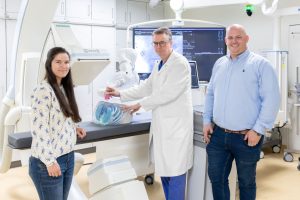

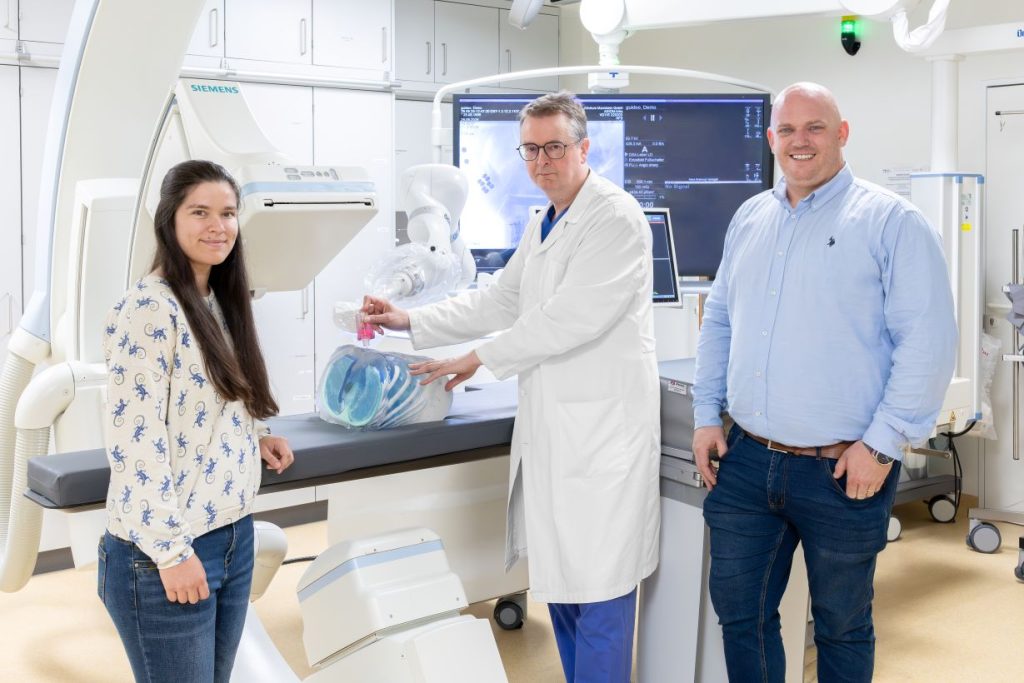
For the research project “Technical Translation and Clinical Evaluation of a Pre-existing C-Arm-Based Robotic Assistance System for Spiral Computed Tomography,” the Health + Life Science Alliance Heidelberg Mannheim provided funding of up to 200,000 euros as part of its Industry Program. The project partners are the Heidelberg University Mannheim Medical Faculty and the industrial company BEC Medical GmbH.
The goal of the project, known as “guidoo CT,” is the technical development and clinical testing of the guidoo robotic assistance system for use in needle-based, percutaneous, image-guided procedures using conventional spiral computed tomography (CT). The system was originally developed as part of the M²OLIE Research Campus for use in combination with cone-beam CT (CBCT) and has already been clinically validated at the University Medical Center Mannheim. Thanks to image-guided access planning, it enables precise and reproducible needle placement, thereby significantly reducing the duration of the procedure. In this way, the technology helps standardize complex image-guided procedures and facilitate access to minimally invasive techniques. Building on this, the original system variant received MDR certification in the first half of 2026. The newly funded project aims to adapt the robotic assistant “guidoo” technically for use with conventional spiral CT and subsequently evaluate it as part of a prospective clinical study. The study will focus in particular on safety, precision, user-friendliness, and the integration of the system into existing clinical workflows. At the same time, the study is intended to generate the necessary clinical evidence for a future regulatory expansion of the technology. The goal is to significantly expand the system’s range of applications. In the long term, this should facilitate the use of robot-assisted interventions under CT imaging in routine clinical practice and support the widespread adoption of minimally invasive therapeutic procedures. The project combines scientific expertise with industrial development expertise. Mannheim University Medical Center is contributing its expertise in interventional radiology in particular, while BEC Medical GmbH is involved as an industry partner for the technical development of medical robotics. The further development of this technology is expected to make a significant contribution to further strengthening the Rhine-Neckar metropolitan region and the members of the Health and Life Science Alliance as a leading hub and experts in innovative medical technology. At the same time, the project builds directly on the work of M²OLIE. The research campus aims to treat cancer patients with oligometastases as gently and efficiently as possible. Innovative robot-assisted and image-guided procedures play a key role in making complex tumor treatment procedures more precise, less invasive, and more efficient.
Further Information
Funding Period
The grant provides up to 200,000 euros for the period from April 1, 2026, to March 31, 2028. The project officially began in April 2026.
Funding Program
The Health + Life Science Alliance Heidelberg Mannheim is funded by the Ministry of Science, Research, and the Arts of the State of Baden-Württemberg and is an interinstitutional network of leading scientific and medical institutions in the region that strengthens collaboration in the health and life sciences and drives innovative research. Through the Alliance Industry Program, the Alliance specifically promotes collaboration between academia and industry. The focus is on research projects that, in collaboration with industry partners, further develop scientific findings into concrete applications, thereby strengthening technology transfer and the region’s innovative capacity.
Name and Institution of the Project Leader
Prof. Dr. med. Steffen Diehl
Deputy Clinic Director
Head of the Interventional Radiology Section
Department of Radiology and Nuclear Medicine
Theodor-Kutzer-Ufer 1-3
68167 Mannheim
About the Mannheim Medical School/M²OLIE
The M²OLIE Research Campus is a public-private partnership based at the University Medical Center Mannheim that has been funded by the Federal Ministry of Research, Technology, and Space since 2013. This interdisciplinary research network brings together science, medicine, and industry under one roof and focuses on researching new, personalized treatment concepts for cancer patients with oligometastases. The goal is to provide precise, minimally invasive, and time-efficient treatment, as well as an optimized process from patient admission to discharge.
About BEC Medical GmbH
BEC Medical GmbH specializes in the development and integration of robot-assisted automation solutions for medical applications. The company supports projects throughout their entire lifecycle–from conception and technical planning through commissioning to ongoing support.